

TL;DR:
- Different A Level maths exam boards have distinct specifications, question styles, and assessment structures that influence the content and skills you need to master.
- Knowing your specific board's format allows for targeted revision, improves mock performance, and reduces confusion caused by varying question wording and mark schemes.
Not all A Level maths exams are the same, and if you think they are, you are already at a disadvantage. A-level maths in England is set by exam boards, each with its own specification, question style, and assessment structure. These are not minor cosmetic differences. They shape what content you need to know, how questions are worded, and even which applied topics appear on your paper. Understanding the distinctions between exam publishers is one of the most underrated moves a serious maths student can make heading into their A Level year.
Table of Contents
- What is an exam publisher for A Level maths?
- Comparing the major A Level maths exam boards
- How exam board differences affect your revision and results
- Adapting your preparation: strategies for your exam board
- The truth about exam boards: what most students miss
- Next steps: get ahead with board-specific resources
- Frequently asked questions
Key Takeaways
| Point | Details |
|---|---|
| Know your exam board | Each board has its own style and focus, so tailoring your revision gives you a vital edge. |
| Exam format matters | Assessment style, question wording, and topic emphasis differ between boards—practise with board-specific papers. |
| Preparation boosts results | Aligning revision with your exam board helps improve accuracy and confidence in the real exam. |
| Resources are key | Use past papers, mark schemes, and targeted practice materials matched to your board for the best outcomes. |
What is an exam publisher for A Level maths?
The term "exam publisher" is sometimes used loosely, but in the world of A Level maths, it refers to what are formally called exam boards or awarding bodies. These are organisations that design the syllabus, write the exam papers, set the mark schemes, and ultimately decide how your knowledge is assessed. They are not interchangeable. Each board produces a distinct specification that your school follows, and your exam papers come directly from whichever board your school has chosen.
There are four recognised A Level exam boards in England, and knowing them is the first step to smarter revision. The principal boards are:
- AQA (Assessment and Qualifications Alliance): the most widely used board in England, known for a broad, integrated approach to topics.
- Pearson Edexcel: preferred by many independent schools, recognised for its clear question layout and structured paper format.
- OCR (Oxford, Cambridge and RSA): offers two pathways, OCR A and OCR B (MEI), with OCR B being notably more conceptual and investigative.
- WJEC Eduqas: primarily used in Wales but accepted in England, with a reputation for accessibility in question style.
There is also CIE (Cambridge International Examinations), which serves international students and those in some independent schools in England. CIE operates its own distinct International A Level structure, which differs from the reformed English A Level format.
"Choosing your board is not just a school admin decision. It defines the maths you will be examined on and the style in which you will be asked to demonstrate it."
If you want to explore the examples of exam boards in more detail before diving deeper, it is worth familiarising yourself with each board's overall philosophy, not just its content list.
Comparing the major A Level maths exam boards
Each exam board offers its own specification including optional components, and the differences go well beyond surface-level branding. Here is a direct comparison of what matters most for your revision:
| Feature | AQA | Edexcel | OCR A | OCR B (MEI) |
|---|---|---|---|---|
| Core content | Pure maths across all papers | Pure maths across all papers | Pure maths across all papers | Pure maths across all papers |
| Applied topics | Statistics and mechanics (blended) | Statistics and mechanics (separate paper) | Statistics and mechanics | Statistics, mechanics, and modelling |
| Decision maths | Not included | Not included | Not included | Included as optional |
| Question style | Scenario-rich, wordy | Clear and structured | Mixed style | Conceptual, proof-heavy |
| Mark scheme detail | Moderate | High | Moderate | Very detailed |
| Large data set (LDS) | Yes | Yes | Yes | Yes |
A few things stand out in this comparison. Edexcel is widely regarded as the most predictable in terms of exam structure, meaning students often find it easier to know what to expect from each question type. AQA tends to blend statistics and mechanics within a single applied paper rather than separating them rigidly, which can make revision planning slightly less straightforward. OCR B (MEI) stands apart for including decision maths and for its emphasis on mathematical reasoning over rote procedures.
Here is a numbered breakdown of the key assessment differences that directly affect your exam experience:
- Paper structure: Edexcel splits its A Level into three papers, two pure and one applied. AQA does the same, but the applied paper mixes mechanics and statistics in a way that is less predictable.
- Question complexity: OCR B papers regularly ask students to interpret models and justify methods, not just calculate answers. This rewards conceptual understanding above speed.
- Context and wording: AQA questions frequently embed maths within real-world scenarios. This means reading comprehension plays a surprisingly large role in your ability to pick out the correct mathematical operation.
- Large data set use: All four main boards require familiarity with a large data set for statistics questions, but the data itself and how it is used in questions varies between boards.
Pro Tip: If you are revising for Edexcel, pay close attention to the way questions build mark by mark. The structured layout means each part of a question typically tests a distinct skill, making it easier to earn partial marks even when you are unsure of the final answer.
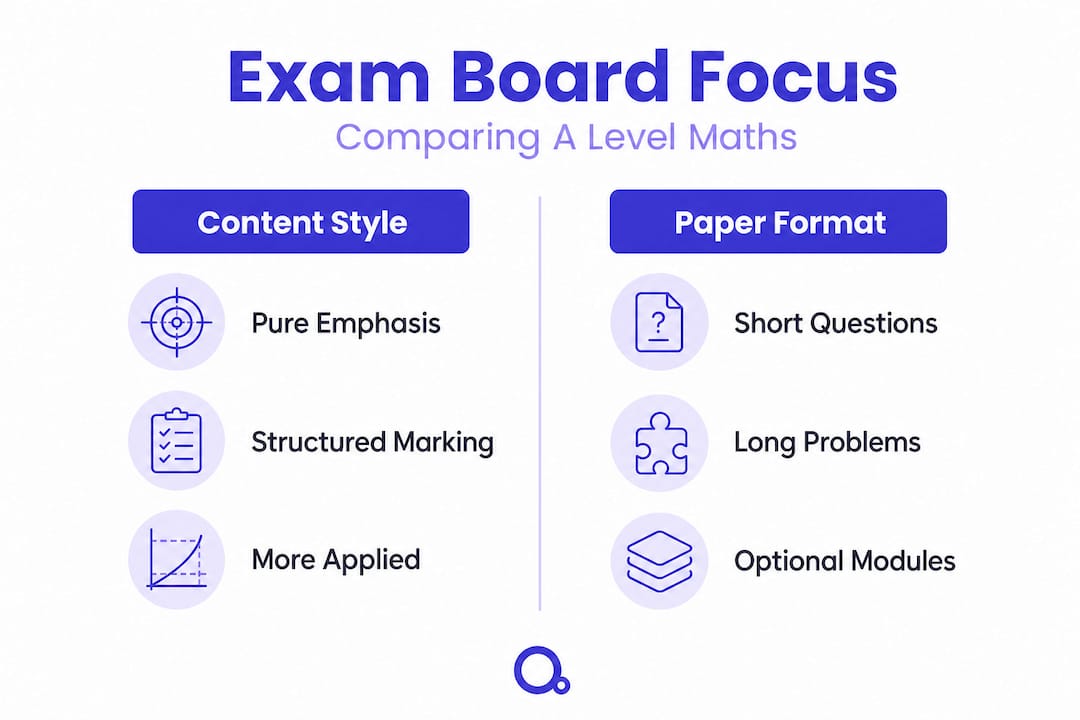
When you compare exam boards side by side, the most important insight is that no single board is objectively harder. Each rewards different skills, and success depends on how well your revision matches the board's expectations.
How exam board differences affect your revision and results
Now let us dig into how these differences actually play out in your study routine and exam success. Different publishers' specifications mean content and assessment can differ in ways that directly influence what you should be spending your revision time on.

The most immediate impact is on topic prioritisation. If you are sitting OCR B, spending significant time on decision maths is entirely necessary. If you are on AQA, that same time is completely wasted because decision maths does not appear. Revising without knowing your board's specification is like revising for the wrong exam entirely.
Beyond content, question wording and layout create subtler but equally important differences. Consider analysing exam board questions from your specific board rather than mixing questions from multiple boards indiscriminately. Why? Because the way a question is phrased trains your brain to interpret a particular style of mathematical request. Switching between boards mid-revision can actually build confusion rather than confidence.
Here are some concrete ways board-specific revision makes a difference:
- Mock exam accuracy: Students who practise exclusively with their board's past papers score noticeably higher on their mocks than those who mix papers from multiple boards without focus.
- Mark scheme familiarity: Each board's mark scheme uses different notation and language to indicate method marks versus accuracy marks. Knowing your board's conventions means you lose fewer marks for presentation errors.
- Timing calibration: Paper lengths and question counts differ between boards. If you are timing your practice with the wrong board's papers, your pacing in the real exam will be off.
"Targeted revision is always more efficient than generic revision. The students who know their specification inside out do not just answer correctly more often. They answer more efficiently, and that matters under exam conditions."
Understanding exam question difficulty as it varies by board is also underappreciated. Edexcel's early-question difficulty tends to ramp up more gradually, giving students confidence before reaching harder material. AQA can introduce more demanding contextual problems earlier in the paper. Neither approach is better, but knowing this changes how you should manage your time within the exam itself.
For a full picture of revision best practices that apply regardless of board, it pays to build your general skills first before drilling board-specific question styles.
Pro Tip: Build a simple spreadsheet listing every topic in your board's specification. Rate your confidence in each one from one to five. Prioritise topics where you score two or below, and check that every topic on your list actually appears in your board's specification, not a neighbouring board's.
Adapting your preparation: strategies for your exam board
Understanding what makes each board unique is only half the story. Here is how to translate that into study success.
Each exam board has its own past papers and support material, and using the right ones is non-negotiable. Here is a numbered action plan for board-specific preparation:
- Download your board's specification first: Every exam board publishes its full specification freely online. Print it or save it. Every revision session should be anchored to a specific topic from this list.
- Use only your board's past papers for timed practice: Mixed practice has a place for building general fluency, but timed mock conditions should always use authentic papers from your board.
- Study the mark scheme alongside answers: Do not just check whether you got the right answer. Understand why the mark scheme awards marks where it does, and match your working style accordingly.
- Focus applied topic revision on your board's emphasis: If your board emphasises kinematics heavily within mechanics, allocate more time there. If your specification leans towards hypothesis testing in statistics, practise those question types intensively.
- Use board-specific resources alongside official materials: Third-party platforms that organise questions by board, topic, and difficulty can dramatically speed up targeted revision.
Here is a quick reference table to guide your resource use by board:
| Exam board | Key revision focus | Applied topic emphasis | Useful resource type |
|---|---|---|---|
| AQA | Blended applied paper, real-world context | Statistics and mechanics mixed | Past papers, topic-filtered question banks |
| Edexcel | Structured question parts, clear mark schemes | Statistics and mechanics separated | Past papers, worked solutions |
| OCR A | Varied question style, proof elements | Statistics and mechanics | Topic-by-topic question practice |
| OCR B (MEI) | Conceptual reasoning, decision maths | Statistics, mechanics, decision | Modelling questions, conceptual drills |
| CIE | International format, module choices | Varies by module selection | Module-specific past papers |
If you want to see worked examples that reveal how different boards frame the same mathematical concept, exam questions with solutions are one of the most efficient revision tools available.
Learning how to answer exam questions in the style your board rewards is a skill in itself, quite separate from mathematical ability. AQA students, for instance, need to practise extracting mathematical tasks from wordy problem setups. Edexcel students benefit from rehearsing systematic, step-by-step working that mirrors the mark scheme structure.
If you are sitting AQA, the AQA revision guide offers a focused breakdown of the specification's demands, which is a strong starting point for any dedicated revision plan.
Pro Tip: Attempt at least six full past papers from your specific board under genuine timed conditions before your actual exam. Six papers is the baseline, not the ceiling.
The truth about exam boards: what most students miss
Let us step back from the technical details and take a candid look at what really counts.
There is a tendency among A Level maths students to treat exam board comparison as an end in itself. Forums fill up with debates about which board is "easiest" or "hardest," and students sometimes waste weeks trying to understand boards that are entirely irrelevant to their own exam. This is a distraction, and an expensive one in terms of revision time.
Here is the uncomfortable truth: the board-specific differences that genuinely affect your grade are narrower than most students assume. The core pure mathematics content, from calculus to vectors to trigonometry, is almost identical across all four boards. The real differentiators are in applied topics and question style, not in the fundamental mathematics itself.
What actually separates top-performing students from average ones is not deep knowledge of their board's quirks. It is consistent, high-volume practice with the right questions, combined with honest self-assessment of weak areas. A student who completes 200 past paper questions from their specific board and reviews every mistake will outperform a student who reads extensively about board differences but practises less.
The experienced students and teachers who consistently see strong results share a common insight: understanding your board creates the framework for revision, but deliberate practice is what fills that framework with results. When you use a smarter exam board comparison approach, you are not just gathering information. You are building a targeted revision engine.
Do not let board-awareness become a form of productive-feeling procrastination. Learn the key differences quickly, apply them to your revision plan, and then get to work.
Next steps: get ahead with board-specific resources
Ready to move from strategy to action? Your next step is to choose resources truly matched to your exam board.
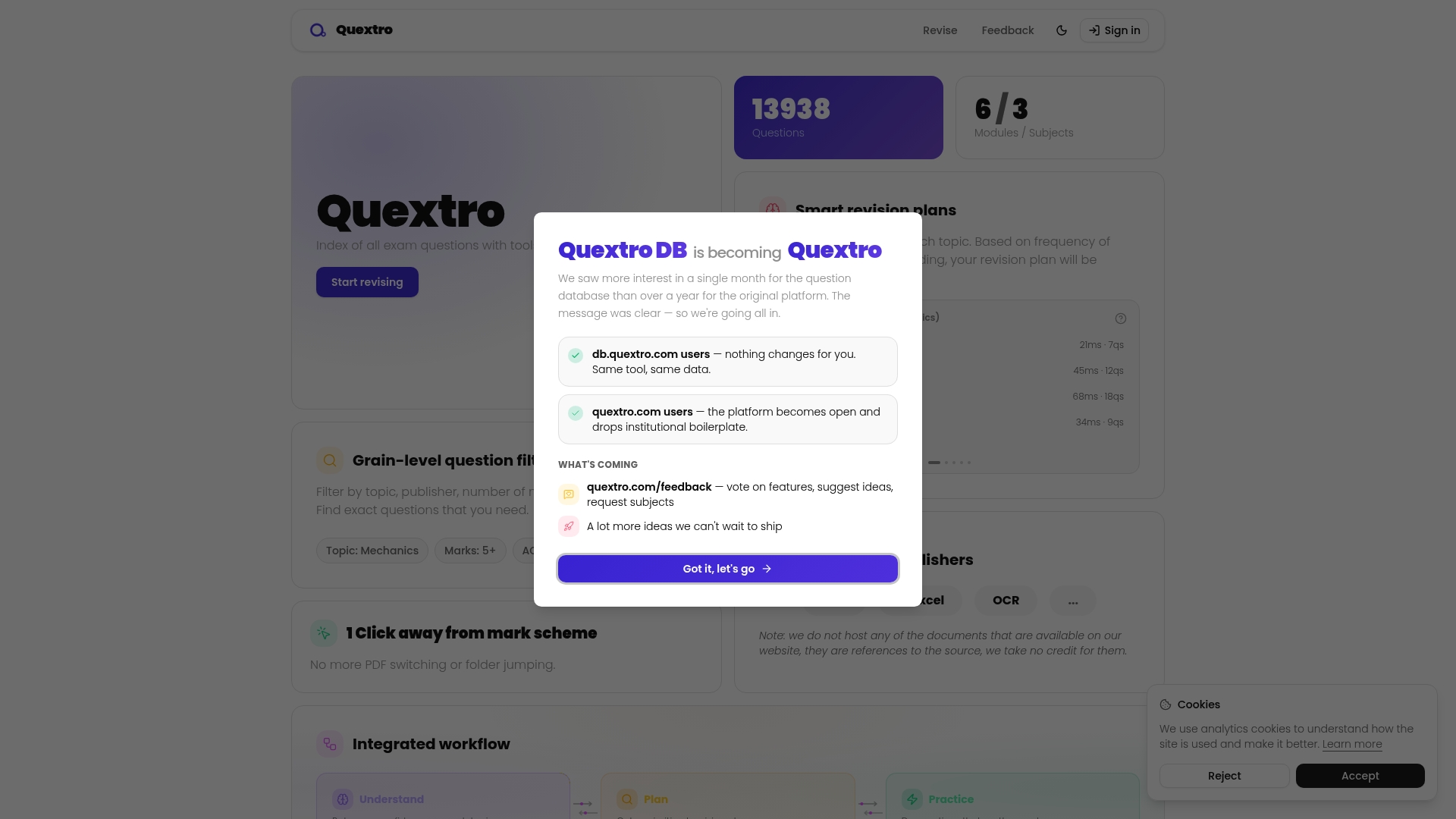
Quextro gives you access to over 13,955 past exam questions organised by board, topic, difficulty, and marks. Rather than searching through PDFs or mixing unrelated papers, you can filter directly to questions from AQA, Edexcel, OCR, or CIE that match exactly what you are revising. The platform's smart revision plans adapt to your confidence ratings, so weaker topics automatically receive more attention without you having to micromanage your schedule. Whether you need to drill statistics maths papers, work through decision maths papers, or build fluency with foundation maths papers, Quextro's board-specific modules put targeted practice at the centre of your preparation from day one.
Frequently asked questions
Why do different exam boards exist for A Level maths?
Exam boards set their own A Level maths specifications and assessments to offer schools and students genuine choice in approach, style, and emphasis while still meeting national standards overseen by Ofqual.
Does every school offer all exam boards for A Level maths?
No. Schools select preferred boards for each subject, so most students follow whichever board their school has chosen rather than selecting one themselves.
Are A Level maths results viewed differently by universities depending on exam board?
Universities treat all recognised boards' qualifications as equally valid for entry purposes, so the grade you achieve matters far more than which publisher set your paper.
Can I switch exam boards during my A Level maths course?
Switching boards is technically possible but not generally recommended, as it involves adjusting to a different specification mid-course and can disrupt your preparation significantly.