

TL;DR:
- True comprehensive exam prep involves revisiting all topics regularly, not just practicing familiar areas.
- Combining timed past papers with active recall and spaced repetition improves long-term retention and exam readiness.
- Using a structured plan, diverse resources, and honest self-assessment is key to mastering A Level maths efficiently.
Spending six hours on past papers and calling it exam prep is a trap many A Level maths students fall into. Real, thorough revision is far more structured than that, and the students who score top marks know it. Comprehensive examination definition clarifies that this kind of prep means preparing thoroughly for a broad assessment covering a wide range of topics, not just the ones you feel comfortable with. This article walks you through exactly what that looks like for A Level maths, from proven strategies and tools to the honest advice most revision guides leave out.
Table of Contents
- What does comprehensive exam prep really mean?
- Building the foundations: Key strategies for A Level maths
- Comparing revision methods: Which strategies yield the best results?
- Essential resources and tools for effective preparation
- A practical take: What most guides miss about mastering comprehensive exam prep
- Prepare smarter: Next steps with Quextro
- Frequently asked questions
Key Takeaways
| Point | Details |
|---|---|
| Comprehensive means cumulative | Effective prep covers every topic, not just individual units. |
| Blend revision strategies | Combine past-paper drills, active recall, and spaced practice for top results. |
| Use the right resources | Collect past papers, guides, and digital tools to make revision efficient. |
| Flexible plans work best | Build in adaptability and honest self-assessment when planning revision. |
What does comprehensive exam prep really mean?
The word "comprehensive" gets thrown around a lot, but it has a precise meaning here. According to the Comprehensive examination definition, comprehensive exam prep is preparation for an exam covering an extensive range of topics to test mastery of the whole course. For A Level maths, that means every topic on your specification, from pure maths areas like calculus and algebra to applied units covering statistics and mechanics, is fair game in any single sitting.
This is very different from the kind of revision many students default to. Unit-focused revision, where you drill one topic at a time and then move on, works reasonably well for modular-style assessments. But A Level maths exams are linear. Everything you have studied over two years can appear on the same paper.
"True comprehensive revision for A Level maths means you are never allowed to quietly forget a topic. Every area must remain accessible and practisable right up until exam day."
Here is a quick comparison to show why this distinction matters:
| Feature | Unit-focused revision | Comprehensive exam prep |
|---|---|---|
| Topic coverage | One topic at a time | Entire syllabus simultaneously |
| Retention strategy | Short-term memorisation | Spaced repetition for long-term recall |
| Practice approach | Chapter exercises | Mixed past paper questions |
| Skill tested | Isolated technique | Cross-topic problem solving |
| Best suited for | Modular coursework | Cumulative final exams like A Level |
The shift from unit-focused to comprehensive thinking changes how you plan, what you practise, and how often you revisit earlier material. A structured revision approach is not just helpful here, it is essential. Without one, students inevitably spend too much time on topics they enjoy and quietly avoid the ones they find difficult.
The core skills tested in comprehensive A Level maths exams include algebraic manipulation, proof, integration and differentiation, statistical reasoning, and mechanics modelling. No single one of these can be sacrificed. Using active recall methods to regularly retrieve material from memory rather than re-reading it is one of the most effective ways to keep the whole syllabus accessible at once.
Building the foundations: Key strategies for A Level maths
With an understanding of what comprehensive prep entails, it is time to explore the key strategies that form its backbone for A Level maths. The best revision plans are not the longest ones. They are the most deliberately constructed.
Here is a step-by-step framework to build your foundation:
- Audit your entire specification. Download the official spec from AQA, Edexcel, OCR, or CIE and go through every topic. Mark your current confidence level as high, medium, or low.
- Prioritise by weight and weakness. Topics that carry more marks and feel shakiest deserve the most time early in your revision cycle.
- Introduce spaced repetition from the start. Revisit topics after three days, then a week, then a fortnight. This is how your brain builds durable memory rather than temporary familiarity.
- Integrate timed past paper practice weekly. Do not save papers for the final weeks. Using them throughout your revision provides feedback and builds exam stamina.
- Review every mistake systematically. Every wrong answer contains more information than a right one. Keep a dedicated errors notebook and return to those questions.
- Blend practice formats. Alternate between full past papers, topic-specific question sets, and short timed drills on individual skills.
According to A Level exam strategies, a robust plan combines past-paper practice under timed conditions with structured active recall and spaced practice to improve long-term retention. That combination is what separates students who plateau from those who keep improving.
Pro Tip: Do not spend more than two consecutive revision sessions on the same topic. Interleaving different subjects, even within maths itself, such as switching between calculus and statistics, trains your brain to retrieve knowledge flexibly, which is exactly what A Level papers demand.
Common mistakes to avoid during this phase include:
- Re-reading notes without testing yourself, which feels productive but is not
- Skipping mark schemes and assuming your method was correct
- Practising only the question types you already find easy
- Leaving mechanics or statistics until the last week because they feel optional
- Failing to time practice sessions, which leaves exam stamina underdeveloped
Explore comprehensive maths strategies and the value of past papers for a deeper look at how these individual methods combine into a coherent system.
Comparing revision methods: Which strategies yield the best results?
Having seen the foundations, it is useful to compare common revision methods to decide what combination leads to the best outcomes. Students often get stuck in one mode and miss the benefits of combining approaches.
Some students focus almost entirely on past-paper practice, while others incorporate structured active recall and spaced practice for better retention. Research consistently finds that the hybrid approach outperforms either method alone.
| Method | Strengths | Weaknesses |
|---|---|---|
| Past papers only | Builds exam familiarity, timed discipline | Can mask conceptual gaps, repetitive errors |
| Active recall only | Strengthens memory, reveals weak spots | Less exam technique development |
| Spaced repetition only | Strong long-term retention | Slow to build, needs sustained planning |
| Hybrid approach | Covers all dimensions of exam readiness | Requires more deliberate planning |
Why does the hybrid approach work so well? Because A Level maths exams test two things simultaneously: what you know and how quickly you can apply it under pressure. Pure theory revision strengthens the first. Timed past papers sharpen the second. Neither alone is sufficient.
Statistic to consider: Students who regularly combine timed practice with deliberate review of errors consistently outperform peers who rely on passive re-reading or unreflective past paper completion.
Motivation also plays a larger role than most guides acknowledge. When revision feels like endless reading, engagement drops quickly. Mixing methods, varying question types, and tracking visible progress keeps momentum going across weeks of preparation.
Pro Tip: After completing a timed past paper, spend at least 30 minutes reviewing it against the mark scheme before moving on. The review session is where the actual learning happens. Skipping it wastes the effort you put into the practice.
Understanding your exam technique is also part of this picture. Knowing when to move on from a question, how to structure a proof clearly, and how to interpret a statistics scenario efficiently all require deliberate exam technique strategies alongside content knowledge. These skills take time to build, which is another reason to start early and practise consistently rather than cramming at the end.

Essential resources and tools for effective preparation
Once you know the methods, selecting the right resources makes your revision plan both comprehensive and efficient. Comprehensive exam prep requires a range of resources to cover all topics and skills tested, and choosing those resources carefully saves you considerable time and effort.
The core categories of resources every A Level maths student should use include:
- Past papers and mark schemes: These remain the gold standard. Official papers from your exam board reflect the exact style, wording, and difficulty of what you will face. Mark schemes show you where marks are allocated, which is itself a revision tool.
- Revision guides: A good revision guide condenses the specification into clear summaries. Use them for theory consolidation, not as your primary source of practice.
- Question banks filtered by topic: Rather than completing an entire paper when you only need to practise integration, a topic-specific question bank is faster and more targeted.
- Exam notebooks: Keeping a structured notebook for errors, key formulas, and flagged questions creates a personalised revision resource that evolves with you throughout prep.
- Digital platforms: Online tools that combine question practice, tracking, and spaced scheduling replace multiple separate resources and make comprehensive coverage easier to manage.
Here is a practical guide to how and when to use each:
| Resource | Best used for | When to use |
|---|---|---|
| Past papers | Timed full-paper practice | Weekly from 8 weeks out |
| Mark schemes | Error review and self-assessment | After every practice session |
| Revision guides | Theory consolidation and quick reference | Early revision and before topic drills |
| Question banks | Targeted topic practice | Whenever gaps are identified |
| Exam notebooks | Tracking mistakes and formulas | Continuously throughout revision |
| Digital tools | Scheduling, tracking, mixed practice | Daily, to manage overall plan |
Accessing quality past paper databases saves you the frustration of hunting across different websites for the right papers. A well-organised question library, filtered by topic and difficulty, is one of the most efficient resources available to A Level maths students.
Using an exam notebooks guide can help you set up this system properly from the start, while teacher workflow tips offer useful guidance on how to sequence resources over a full revision timeline.
The scheduling element deserves particular emphasis. Resources are only as useful as the plan that deploys them. A timetable that assigns specific resource types to specific sessions, rather than just listing "maths revision," is significantly more effective for comprehensive coverage.
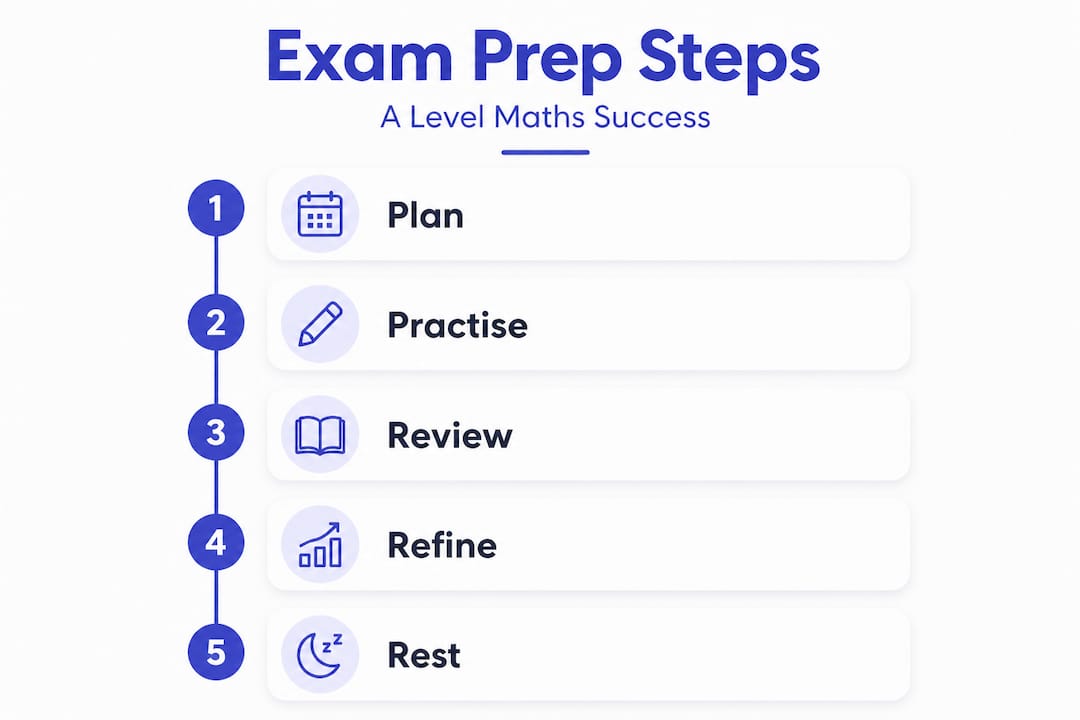
A practical take: What most guides miss about mastering comprehensive exam prep
After exploring recommended strategies and tools, it is worth sharing some honest advice on what actually makes a real difference. Most revision guides are good at telling you what to do. Fewer are honest about the habits and mindset shifts that separate students who execute their plan from those who keep adjusting it.
Here is the first uncomfortable truth: a flexible revision plan beats a perfect one. Students who over-schedule their preparation, assigning every hour across twelve weeks to a specific topic, almost always fall behind within days. Life does not cooperate with rigid timetables. When the plan breaks, motivation collapses with it. A plan built around weekly targets rather than hourly ones is far more resilient and ultimately more productive.
The second overlooked habit is what happens after a timed practice session. Most students close the paper, check their score, feel either relieved or anxious, and move on. The students who improve fastest spend as much time reviewing a paper as completing it. They annotate every mistake. They identify the thinking error, not just the arithmetic slip. They re-attempt the question without looking at the solution. This post-practice routine is where genuine learning consolidates.
There is also a broader point about exam weeks well before the actual exams. Setting aside one full week, roughly six to eight weeks out, where you simulate exam conditions across multiple subjects, including maths, gives you a realistic picture of your readiness before the pressure becomes real. Use that week to stress-test your practical exam prep checklist and identify what needs the most attention in the remaining time.
Rest is not optional. It is part of the revision plan. Students who push through exhaustion and review material late at night retain almost nothing from those sessions. A well-rested brain consolidates memory during sleep. Building rest into your schedule is not a concession to laziness; it is a revision strategy.
Finally, top students are not the ones who know the most. They are the ones who know what they do not know and have a system for fixing it. Honest self-assessment, the kind that is hard to face because it means confronting genuine gaps, is the single most effective habit for comprehensive preparation.
Prepare smarter: Next steps with Quextro
If you are ready to put these strategies into action, here are resources to take your preparation further.
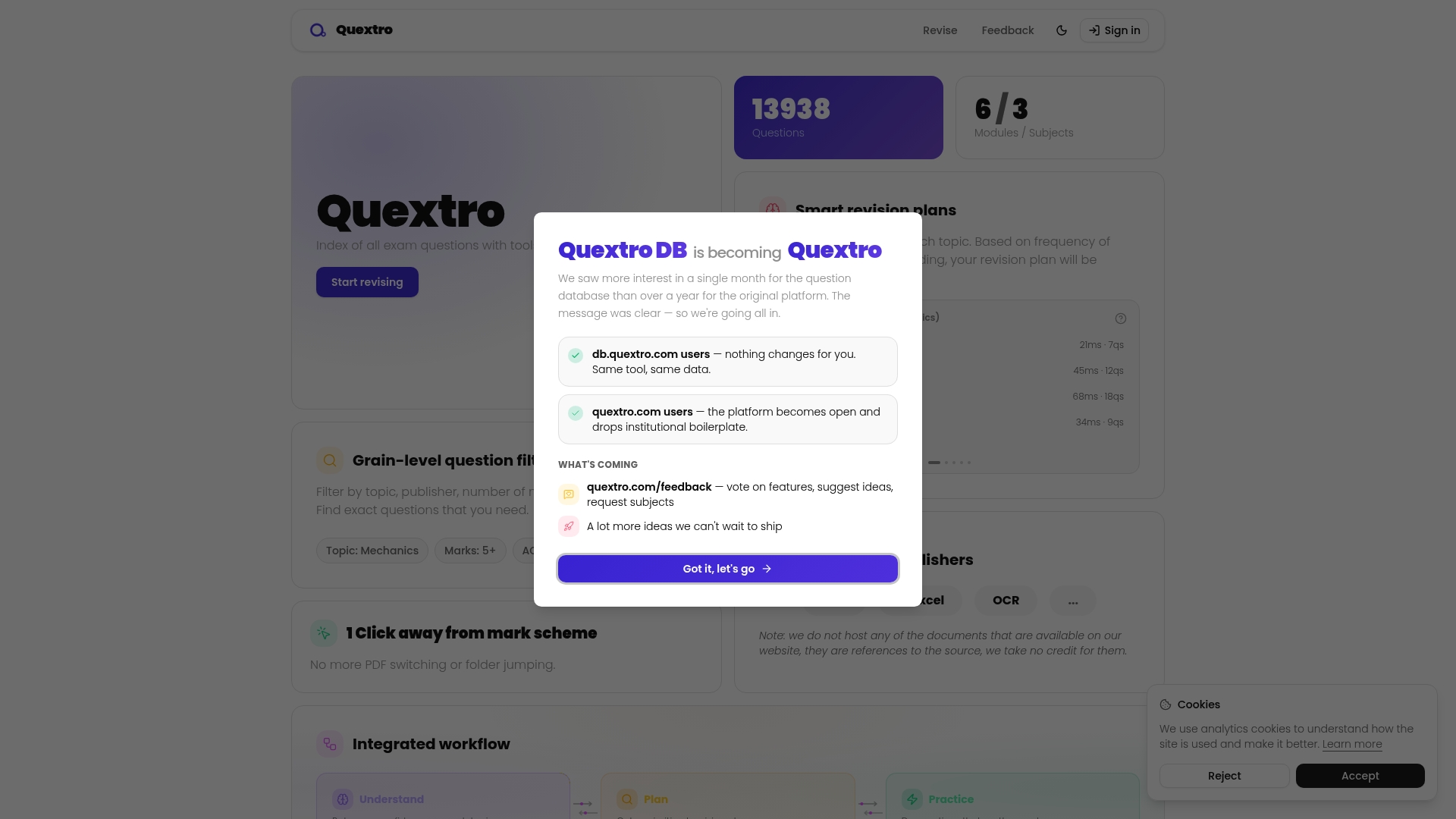
Quextro brings together everything discussed in this article into one focused platform. With a searchable database of over 13,955 past exam questions from AQA, Edexcel, OCR, and CIE, filtered by topic, difficulty, and marks, you can practise exactly where you need to rather than wading through full papers. Smart revision plans adapt to your confidence ratings, and question notebooks let you track errors without managing separate files. Whether you are targeting specific weak spots or working through the full syllabus, the Further Mathematics revision plan and the Statistics papers and questions library are excellent starting points for structured, comprehensive preparation.
Frequently asked questions
How is comprehensive exam prep different from regular revision?
Comprehensive exam prep covers the entire syllabus with techniques for retention and mastery, not just isolated units. As the Comprehensive examination definition confirms, it is preparation for an exam that tests mastery across an extensive range of topics.
Should I focus more on past papers or theory revision?
A blend of both delivers the best results. A Level exam strategies confirm that combining timed past-paper practice with structured active recall and spaced repetition improves long-term retention more effectively than either approach alone.
Which resources are essential for comprehensive A Level maths prep?
Past papers, mark schemes, revision guides, and digital exam tools are all essential. The Comprehensive examination definition makes clear that thorough prep requires a range of resources to cover all topics and skills tested.
How far in advance should exam prep start to be comprehensive?
Begin at least 8 to 12 weeks before your exams to allow adequate time for spaced repetition and practise across all topics. Starting earlier means you can revisit every area of the specification at least twice before sitting the paper.