

TL;DR:
- Effective revision involves goal setting, structured planning, and focusing on weak topics.
- Active techniques like self-testing and error logging significantly improve long-term retention.
- Analyzing past papers and tracking mistakes helps target specific areas for focused improvement.
Even the most dedicated A Level maths students can find themselves trapped in a frustrating cycle: hours of revision, yet exam results that don't reflect the effort invested. The problem is rarely hard work. It's the type of work. Stacking up completed past papers without reviewing errors, or passively re-reading notes without testing yourself, gives a false sense of progress. This guide breaks down the strategies that actually move the needle, from goal setting and active revision to targeted practice and continuous improvement, so you can revise smarter and walk into your exam feeling genuinely prepared.
Table of Contents
- Set clear goals and structure your revision
- Master active revision techniques for lasting retention
- Leverage exam papers and topic analysis for targeted progress
- Review mistakes and adapt for continuous improvement
- Why exam success is less about talent and more about strategy
- Take your revision to the next level with Quextro
- Frequently asked questions
Key Takeaways
| Point | Details |
|---|---|
| Plan with purpose | Set realistic goals and structure your revision to cover every topic efficiently. |
| Use active revision methods | Engage with the material by practising questions, teaching out loud, and self-testing. |
| Practise smart, not just hard | Select exam papers and topic analysis to target weaknesses, not just complete every paper. |
| Learn from mistakes | Study your errors and adapt your approach for continual improvement. |
| Strategy wins over talent | Consistent, smart revision routines are the real key to exam success—not just natural ability. |
Set clear goals and structure your revision
Structured planning is the foundation every successful A Level maths student builds upon. Without it, revision becomes reactive, jumping between topics based on mood rather than need, and weeks slip by without meaningful progress.
Start by mapping out the full specification for your exam board, whether that's AQA, Edexcel, OCR, or CIE. List every major topic area: algebra, calculus, statistics, mechanics, and so on. Then rate your current confidence in each one. This simple exercise immediately shows you where your time should go, and it stops you from over-revising topics you already understand well.
Once you have your topic map, build a revision timetable around it. Assign specific topics to specific sessions and treat those blocks like appointments. Research confirms that structured exam prep genuinely improves performance in A Level maths, and the reason is straightforward: consistency beats intensity. Four focused 45-minute sessions across a week produce better retention than one four-hour cramming sprint.
Breaking the specification into manageable chunks is equally important. Trying to tackle "calculus" in one sitting is demoralising. Instead, narrow it to "integration by substitution" or "differentiation of trigonometric functions." Smaller targets make it easier to measure progress and feel a sense of accomplishment.
Here are some practical elements to include in your revision plan:
- Milestone targets: Set weekly goals, such as completing all integration topic questions from the last three years.
- Review slots: Schedule time at the end of each week to revisit anything that didn't go well.
- Flexible buffers: Leave one session per week unassigned so you can catch up without falling behind.
- Exam board alignment: Follow the best practices for exam preparation specific to your board.
Pro Tip: Colour-code your timetable by topic difficulty. Red for the areas you find hardest, green for those you're confident in. This visual system makes it obvious at a glance whether your plan is weighted correctly.
Milestones also keep motivation high. When you tick off "completed all trigonometry questions at difficulty level 4," that's a concrete win. Over weeks, those wins compound into serious exam readiness.
Master active revision techniques for lasting retention
With your revision framework established, the next step is using methods that make your learning truly stick. Passive revision, re-reading notes, highlighting textbooks, and watching video tutorials without pausing to try the problems, feels productive but rarely leads to real understanding.
Active revision forces your brain to retrieve information rather than simply recognise it. The difference is enormous. Here are five active techniques worth incorporating:
- Closed-book practice: Attempt questions without looking at notes first. Only check answers once you've made a genuine attempt.
- Teach it out loud: Explain a concept as if you're teaching a friend. Gaps in your explanation reveal gaps in your understanding.
- Mixed practice sessions: Avoid doing 30 identical questions in a row. Mix topics within a single session to strengthen the ability to identify which method applies.
- Error logging: After every practice session, note which question types caused problems and why.
- Self-testing with spaced repetition: Return to topics you've already covered at increasing intervals to reinforce long-term retention.
As noted in exam technique strategies, active revision through answering questions and explaining concepts outperforms passive review by a significant margin. Your brain strengthens the pathways it uses, so make it work during revision, not just during the exam.
"The goal of revision isn't to feel familiar with content. It's to be able to reproduce it under pressure, accurately and efficiently."
An exam notebook is one of the most underused tools available to A Level students. Keep a dedicated notebook where you log every question you got wrong, the correct method, and a brief note on why you made the error. Over time, you'll notice patterns. Perhaps you consistently drop signs in differentiation or misread probability questions. Spotting these patterns is the first step to eliminating them.
Pro Tip: After finishing a practice paper, don't just mark it. Spend at least as long reviewing the questions you got wrong as you did completing the paper. This review phase is where the real learning happens.
For more maths exam tips on structuring active sessions effectively, it's worth exploring resources that align with your specific exam board format.
Leverage exam papers and topic analysis for targeted progress
Having learned how to revise actively, it's crucial to harness the power of practice papers and topic analysis. Not all exam practice is equal. Simply downloading every past paper and working through them in chronological order is a common approach, but it's far from the most efficient one.

The smarter approach involves selecting the right exam questions based on your personal progress. If integration is your weak area, concentrate your practice there rather than spending equal time on topics you've already mastered. This is where topic-specific filtering becomes invaluable.
Here's a comparison of common revision approaches:
| Approach | Time efficiency | Targeted? | Progress tracking |
|---|---|---|---|
| Chronological past papers | Low | No | Difficult |
| Worksheet repetition | Medium | Partially | Limited |
| Topic-filtered question practice | High | Yes | Clear and measurable |
| Smart adaptive tools | Very high | Fully | Automatic |
As shown, exam topic analysis that targets individual strengths and weaknesses is significantly more effective than repeating full papers without purpose. Knowing which topics account for the most marks, and which you're least secure in, lets you prioritise with precision.
Building a data-driven progress system doesn't need to be complicated. Track the following:
- Topics attempted this week
- Questions answered correctly vs. incorrectly by topic
- Confidence rating before and after practice
- Mark schemes reviewed after each question
Use your findings to organise exam questions into categories: mastered, in progress, and needs urgent attention. This simple system transforms your revision from guesswork into a structured improvement plan.
Balancing breadth and depth also matters as your exam approaches. In the early revision phase, cover all topics broadly. In the final four to six weeks, shift focus towards your weakest areas and highest-mark question types. This sequencing prevents the common mistake of spending the final weeks polishing topics that are already secure.
Review mistakes and adapt for continuous improvement
Practice alone isn't enough; reviewing what goes wrong is where significant improvement occurs. Many students complete a practice paper, check the mark scheme briefly, and move on. This wastes the most valuable part of the exercise.
Reviewing errors thoughtfully is a skill in itself. Use this four-step process:
- Identify the error type: Was it a misread question, a calculation slip, a conceptual gap, or a missing method step?
- Find the correct method: Work through the solution fully using the mark scheme or your notes.
- Log it: Record the question, the error type, and the correct approach in your error log.
- Reattempt it: Come back to the same question type within 48 hours without looking at your notes.
Regular reviewing exam answers leads to measurably higher subsequent grades, because each review session closes a specific gap rather than leaving it to resurface in the real exam.
Here's an example of a simple error tracking table you can build yourself:
| Date | Topic | Error type | Correct method noted | Reattempted? |
|---|---|---|---|---|
| 3 Feb | Integration | Calculation slip | Yes | Yes |
| 7 Feb | Probability | Conceptual gap | Yes | No |
| 12 Feb | Vectors | Misread question | Yes | Yes |
This table turns vague frustration into actionable data. Over a month of consistent logging, you'll see clearly which error types keep appearing, and that tells you exactly where to focus.
Using exam notebooks alongside this table creates a powerful feedback loop. Your notebook holds the worked solutions and method notes; your error table tracks the patterns. Together, they form a personalised improvement system no generic textbook can replicate.
Pro Tip: Set a monthly review date where you go back through your error log, identify the three most frequent mistake types, and dedicate the following week to those specific areas. This keeps your revision responsive rather than rigid.
Adapting your plan based on performance data is what separates students who plateau from those who keep improving. If your error log shows repeated conceptual gaps rather than calculation slips, that's a signal to revisit the underlying theory, not just practise more questions.
Why exam success is less about talent and more about strategy
Once the cycle of review and adaptation is part of your routine, it's worth reflecting on what really drives exam success. There's a persistent myth in maths education that top scorers are simply "naturally gifted." In reality, most high achievers use adaptable, deliberate methods rather than relying on raw ability.
The students who consistently score in the top grades are rarely those who find maths effortless. They're the ones who have built systems: structured timetables, active revision habits, error logs, and topic analysis routines. They make strategic mistakes during revision and learn from them deliberately, rather than hoping they'll perform better next time.
This matters because it means every student can build their own path to exam success. Confidence in maths isn't a prerequisite; it's a result of consistent, organised revision by topic and honest performance tracking. You don't need to be the best in your class to outperform your previous results.
Cramming the night before an exam feels urgent and productive, but it rarely moves grades. A student who spends twelve weeks revising strategically, reviewing errors, and adapting their plan will almost always outperform someone who puts in the same total hours without structure. Strategy, consistency, and adaptability outweigh short-term intensity every time.
Take your revision to the next level with Quextro
For students ready to put these strategies into practice, having the right tools makes a genuine difference.
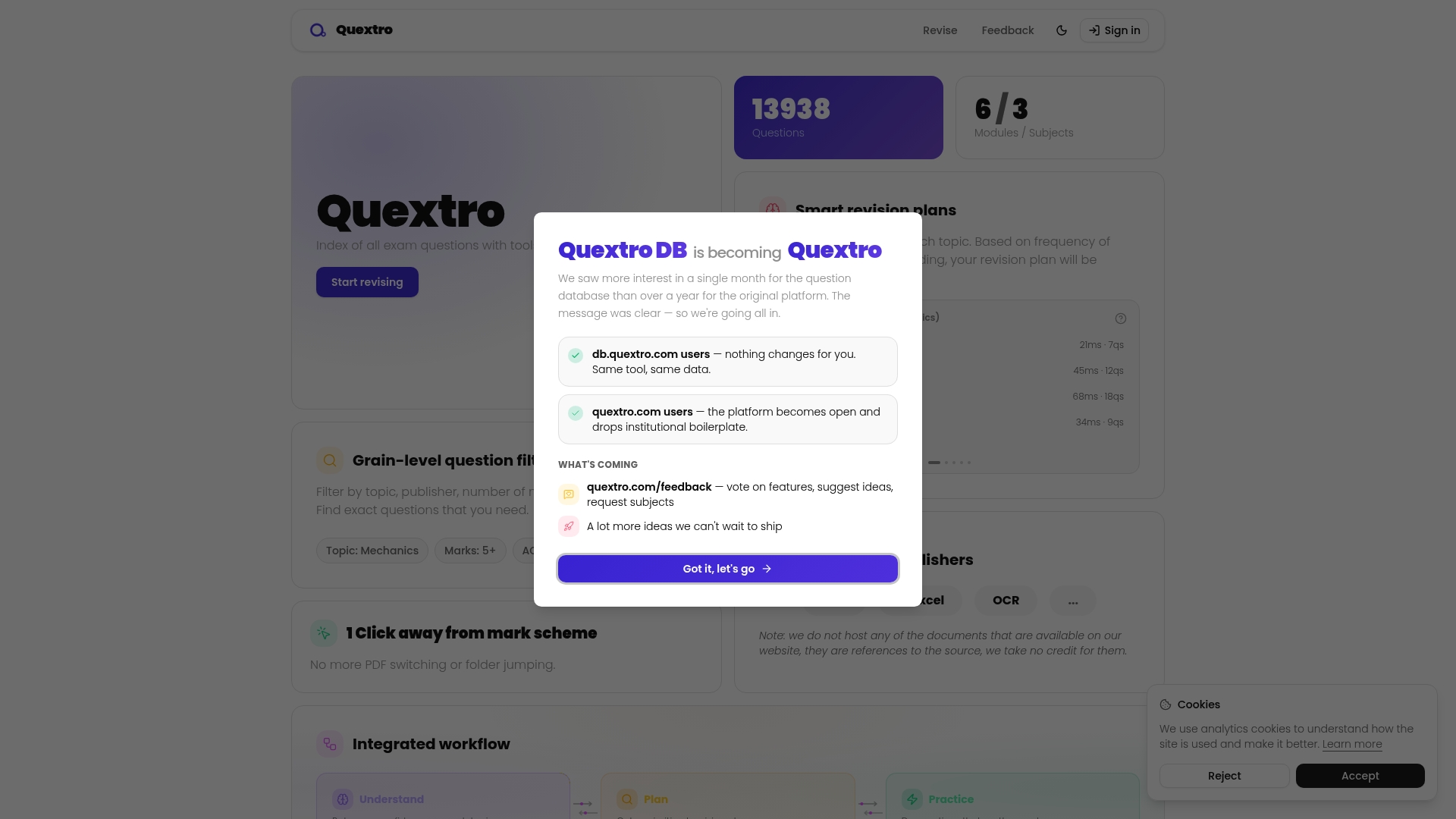
Quextro gives you access to a searchable database of over 13,955 past exam questions, filtered by topic, difficulty, marks, and exam board. Whether you're working through Pure Mathematics revision sets, practising with Statistics practice questions, or tackling Further Maths Q&A, you can target exactly what you need. Rate your confidence per topic, answer questions directly on the platform, and track your progress automatically. No hunting for PDFs. No guessing which questions to do next. Just focused, goal-driven practice that turns the strategies in this guide into real exam results.
Frequently asked questions
How early should I start preparing for A Level maths exams?
Structured preparation over months benefits performance significantly, so aim to begin at least three to six months before your exams. This gives you enough time to cover all topics, build active revision habits, and practise under timed conditions.
What is the most effective way to revise A Level maths topics?
Active revision is superior to passive methods; doing full practice questions, teaching concepts aloud, and reviewing errors will solidify your understanding far more effectively than re-reading notes.
How can I track my progress and spot weak areas?
Question selection and topic analysis reveal where your strengths and weaknesses lie, so use an error log alongside topic-filtered practice to build a clear picture of where to focus your revision time.
Should I focus on past papers or content revision near the exam?
In the final four to six weeks, prioritise past paper practice under timed conditions, but keep revisiting your notes on tricky topics so your conceptual understanding stays sharp alongside your exam technique.