

TL;DR:
- Mock exams are a powerful revision tool that simulate real exam conditions to build stamina and confidence.
- Analyzing mock results helps identify specific weaknesses, enabling targeted and efficient revision.
Most students treat mock exams as something to get through rather than something to get out of. You sit the paper, see a grade, feel relieved or deflated, then move on. But that approach wastes the single most powerful revision tool available to you. Mock exams, done properly, do something that no flashcard or textbook summary can: they place you inside the real experience and generate data about your actual performance under pressure. This article unpacks how to use that data, why the conditions matter, and why mocks carry weight far beyond your personal revision schedule.
Table of Contents
- How mock exams simulate the real test experience
- Mocks as a diagnostic tool for targeted revision
- Why exam conditions and marking criteria matter most
- From mock results to effective feedback and revision
- Why mocks are expected: system and policy
- What most students miss about mock exams
- Take your practice further with Quextro resources
- Frequently asked questions
Key Takeaways
| Point | Details |
|---|---|
| Mocks simulate real exams | Doing mock exams under timed, exam-style conditions best prepares you for the pressure and structure of the actual papers. |
| Mocks drive targeted revision | Mock exam results highlight your specific strengths and weaknesses, helping you focus your study time on areas that need it most. |
| Act on feedback for progress | The true power of mocks comes from using detailed feedback to guide your next steps in revision and exam preparation. |
| Mocks are required for resilience | Exam boards and schools use mock evidence as a backup for grading if usual assessments are disrupted. |
| Iterative practice works | Repeating mocks and reviewing errors deepens understanding and builds long-term A-level maths success. |
How mock exams simulate the real test experience
There is a meaningful difference between knowing how to solve a problem and being able to solve it in silence, against the clock, after two hours of continuous concentration. That difference is what mocks are designed to expose.
A well-constructed mock paper mirrors the actual A-level maths exam in structure, timing, and difficulty. AQA, Edexcel, OCR, and CIE all publish past papers that match their live exam formats precisely, covering the same topic weighting, command word conventions, and mark allocations you will face in the real thing. When you sit a mock under proper conditions, you are not just practising mathematics. You are practising the act of sitting an exam.
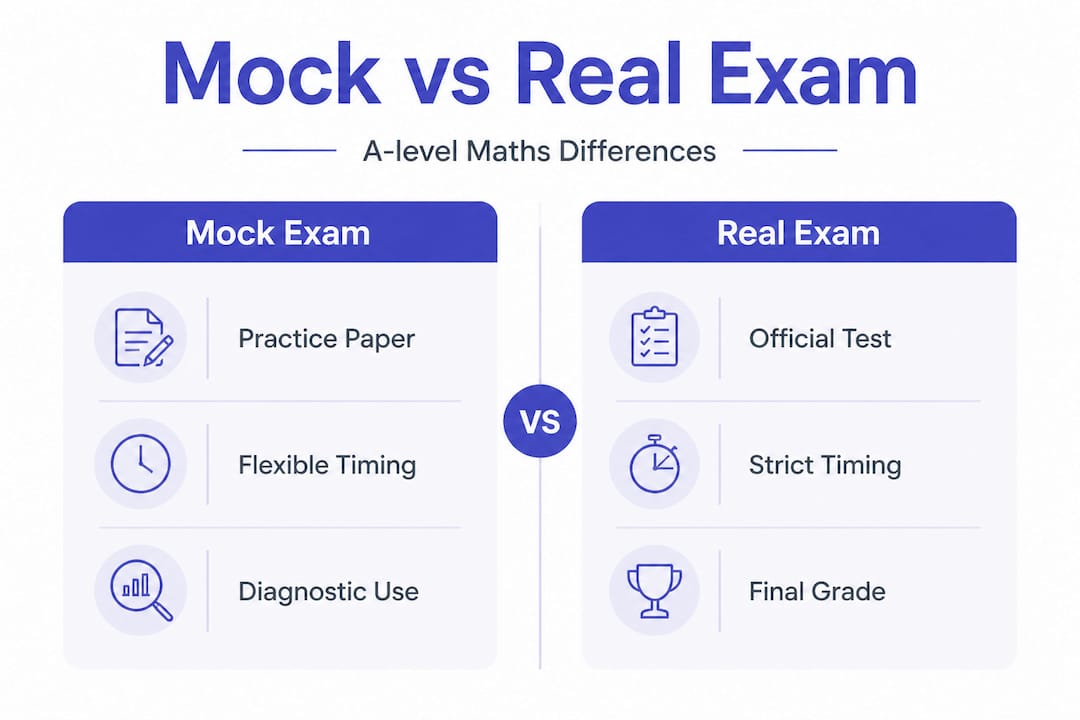
Mocks provide realistic experience of sitting long, high-pressure A-level papers, and that experience simply cannot be replicated by working through questions casually at your desk. The physical and psychological demands are categorically different.
One aspect students consistently underestimate is stamina. A-level maths papers are long. Paper 2 for AQA, for instance, runs to two hours covering pure mathematics and mechanics. Sustaining concentration and accuracy across that duration is a skill in itself, and it is a skill that only develops through repetition. Exam timing boosts performance in ways that casual revision cannot, precisely because timed practice forces you to make decisions under constraint rather than at leisure.
"The exam hall is not the place to discover that you run out of steam after ninety minutes. Your mock is."
The table below compares informal at-home practice with a properly conducted mock exam:
| Factor | Informal practice | Full mock exam |
|---|---|---|
| Time pressure | None or self-imposed | Strict, exam-accurate |
| Environment | Comfortable, distracted | Quiet, controlled |
| Stamina demand | Low | Full exam duration |
| Working method | Flexible | Must show all steps |
| Outcome data | Vague | Specific and actionable |
Pro Tip: Sit your mock in a room where you will not be interrupted. Put your phone in another room entirely. The closer you replicate true exam conditions, the more accurate your results will be as a predictor of your actual grade.
The value of targeted exam practice is amplified enormously when that practice happens in realistic conditions. Without the clock and the pressure, you are training a version of yourself that will not exist on exam day.
Mocks as a diagnostic tool for targeted revision
Once you experience the pressure and structure of a mock, it is time to use the results strategically. A score on its own tells you very little. What matters is the breakdown behind that score.
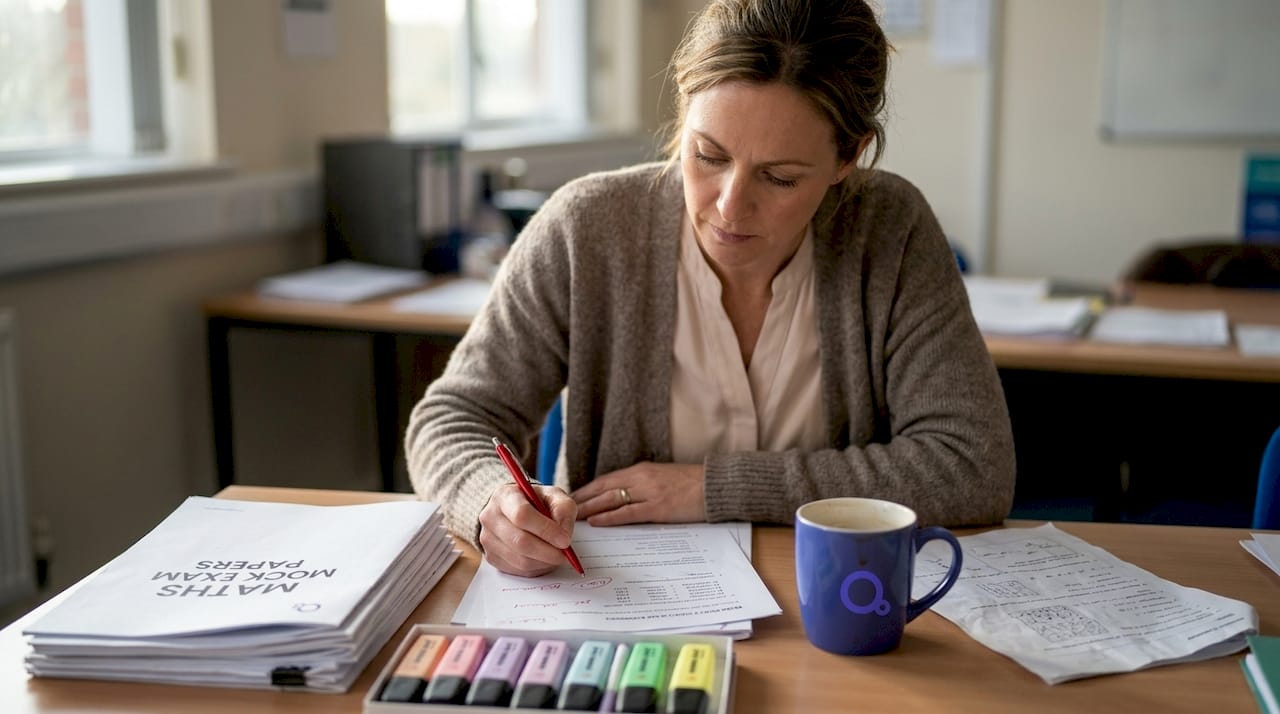
Mocks function as diagnostic tools by revealing how well you apply knowledge rather than simply recall it, and by pinpointing the specific gaps that targeted revision needs to address. This is a crucial distinction. Many students can recite integration techniques in isolation but lose marks the moment those techniques are embedded in an unfamiliar context or chained with another method. A mock exposes that gap. A revision card does not.
The table below illustrates how a diagnostic breakdown might look after a mock:
| Topic area | Marks available | Marks scored | Gap identified |
|---|---|---|---|
| Integration | 18 | 14 | Substitution in complex cases |
| Mechanics (kinematics) | 16 | 9 | Multi-step SUVAT problems |
| Probability and statistics | 12 | 11 | Minor issues with notation |
| Trigonometry | 14 | 7 | Solving equations in range |
| Proof | 8 | 5 | Structure of formal argument |
Once you have a table like this, your revision becomes surgical rather than general. Here is how to interpret your diagnostic results for a meaningful revision plan:
- Identify your lowest-scoring topics first and check whether the errors are conceptual (you misunderstood the method) or procedural (you understood but made execution errors).
- Look for patterns across question types. If you lose marks consistently on multi-step problems, the issue may be systematic reasoning, not topic knowledge.
- Prioritise topics where you dropped the most marks relative to what was available. Trigonometry yielding 50% of available marks is a bigger priority than statistics yielding 92%.
- Review every wrong answer using the mark scheme, not just to see what the answer was, but to understand exactly which step earned which mark.
- Set specific targets for your next revision session, such as completing five integration by substitution questions from past papers before revisiting the mock question you dropped marks on.
Learning how to boost maths revision through question selection is the next logical step once you know which topics need attention. The reason practising exam questions is so effective is precisely because it trains you to apply knowledge in the format you will be tested on, not just to understand it in the abstract.
Students who act on diagnostic data consistently outperform those who revise broadly without direction. Your mock result is not a verdict. It is a map.
Why exam conditions and marking criteria matter most
With a strategic approach to feedback, it is worth understanding the deeper mechanics behind what actually gets rewarded in exam marks. Because marks in A-level maths are not given simply for arriving at the right answer.
Practising under exam conditions helps students internalise exactly what counts for marks and reduces the types of errors that cost points unnecessarily. Method marks, accuracy marks, and follow-through marks each have specific rules. If you do not show your working clearly and in a logical sequence, you can lose method marks even when your final answer is correct.
Here are the most common errors that full mock conditions help students catch and correct:
- Skipping intermediate steps in mechanics problems. Examiners award marks for each stage of reasoning. Missing a step, even if the answer is right, can cost two or three marks.
- Not stating units or defining variables. Particularly in kinematics, omitting units or failing to define the positive direction can result in lost marks.
- Running out of time on the final questions. Without timing practice, students often spend too long on early questions and rush or skip the higher-mark questions at the end.
- Misreading the question under pressure. In casual practice, you re-read at leisure. In an exam, fatigue and nerves lead to misinterpretation. Mocks train you to slow down and annotate questions carefully.
- Forgetting to address all parts of a multi-part question. Part (c) is easy to miss when you are concentrating hard on part (b).
"Exam conditions are not just about replicating stress. They are about learning the discipline of precision under constraint, which is exactly what A-level marking rewards."
Pro Tip: After each mock, mark your own paper using the official mark scheme before your teacher returns it. This forces you to understand the marking logic at a granular level, which directly improves how you write answers in future papers.
Understanding how to answer maths exam questions effectively is inseparable from understanding how they are marked. Once you see the world from the examiner's perspective, your answer structure changes. Exploring exam technique strategies that are specifically designed for A-level maths gives you a structured framework for translating good mathematical understanding into reliable marks.
From mock results to effective feedback and revision
Once you have run a full simulation and reviewed your performance, it is time to make feedback meaningful. Because feedback is only useful if you act on it.
Actionable feedback leads to measurable progress according to the Education Endowment Foundation (EEF), one of the most rigorous sources of educational evidence in the UK. Their guidance is clear: feedback improves learning when it is used to guide the next steps, not treated as a final judgement. A mock score that simply gets filed away fails this test entirely.
"Feedback should be a starting point for action, not an endpoint."
Here is how to convert your mock performance into a structured revision plan:
- Write down three specific weaknesses identified from your mock, each framed as an action. Not "I need to revise integration" but "I need to practise integration by parts with limits, starting with six questions from past Edexcel papers."
- Schedule revision sessions for each weakness within the two weeks following your mock. Delay makes feedback lose its impact.
- Return to the exact questions you dropped marks on after revising the relevant topic. Re-answering the same question after targeted revision is one of the most efficient ways to measure whether your revision actually worked.
- Use a question notebook to log recurring error types. If you keep making the same mistake in different questions, that pattern is more informative than any individual result.
Following exam preparation best practices means building feedback loops into your revision cycle, not just sitting papers and hoping improvement happens passively.
Why mocks are expected: system and policy
Having explored all the personal benefits, it is worth understanding that mocks carry wider significance beyond your individual preparation. Ofqual, the qualifications regulator for England, has clear expectations about how centres conduct and retain mock exam papers.
Regulators expect centres to administer mocks under proper exam conditions and to retain them as potential evidence for alternative awarding scenarios. This became acutely relevant during the pandemic years when Teacher Assessed Grades (TAGs) were used. Mock papers formed a significant part of the evidence base that schools submitted to support grade decisions. In any unexpected scenario where formal exams cannot proceed as planned, your mock performance may carry real weight.
This is why schools require mocks to be taken seriously, in timed conditions, without assistance, and with papers retained:
- Schools are accountable for the evidence they hold, and a poorly administered mock offers weak evidence.
- Your own mock grade may be used formally if the awarding method changes.
- Taking a mock casually may leave you with no credible evidence of your actual capability.
- Centres that follow Ofqual guidance ensure that students are protected in disrupted scenarios.
Pro Tip: Treat every mock as if it will be used in your grade calculation. That mindset improves both your preparation and the quality of evidence your school holds on your behalf.
Understanding Edexcel maths exam structure and how it relates to revision also helps you appreciate why the format of your mock papers matters. Papers built to match live exam specifications carry far more evidential weight than informal worksheets.
What most students miss about mock exams
Here is an uncomfortable truth: most students think of a mock as an event. You sit it, you get a grade, you move on. But the mock itself is actually the least important part of the process. What happens afterwards is where the real value lies.
Mocks only help if you convert them into evidence for next actions. If you sit a paper and then simply wait for the next one, the diagnostic value disappears entirely. The cycle of sitting, analysing, revising, and retesting is what creates meaningful improvement.
The students who gain most from mocks are not necessarily those who score highest on them. They are the ones who interrogate their results with genuine curiosity, compare their answers against mark schemes line by line, and identify recurring themes in their errors. A student who scores 68% and finds three systematic weaknesses is better positioned than a student who scores 75% and assumes they are fine.
Mark scheme comparison is particularly underused. When you read a mark scheme after a mock, you are reading the examiner's logic. You learn how mathematical reasoning gets expressed in formal steps, how partial credit is awarded, and what precision is expected at each stage. That knowledge directly shapes how you write answers going forward.
The best A-level maths exam tips are built on this principle: mocks are a mirror, not a milestone. Look into them honestly, and they will show you exactly what needs to change.
Transform your approach by treating each mock as the beginning of a targeted revision sprint, not the end of one. The grade matters far less than what you do with the information it generates.
Take your practice further with Quextro resources
Applying everything covered in this guide requires more than one or two mock papers. The most effective approach pairs a structured mock strategy with a broad, well-organised bank of targeted practice questions.
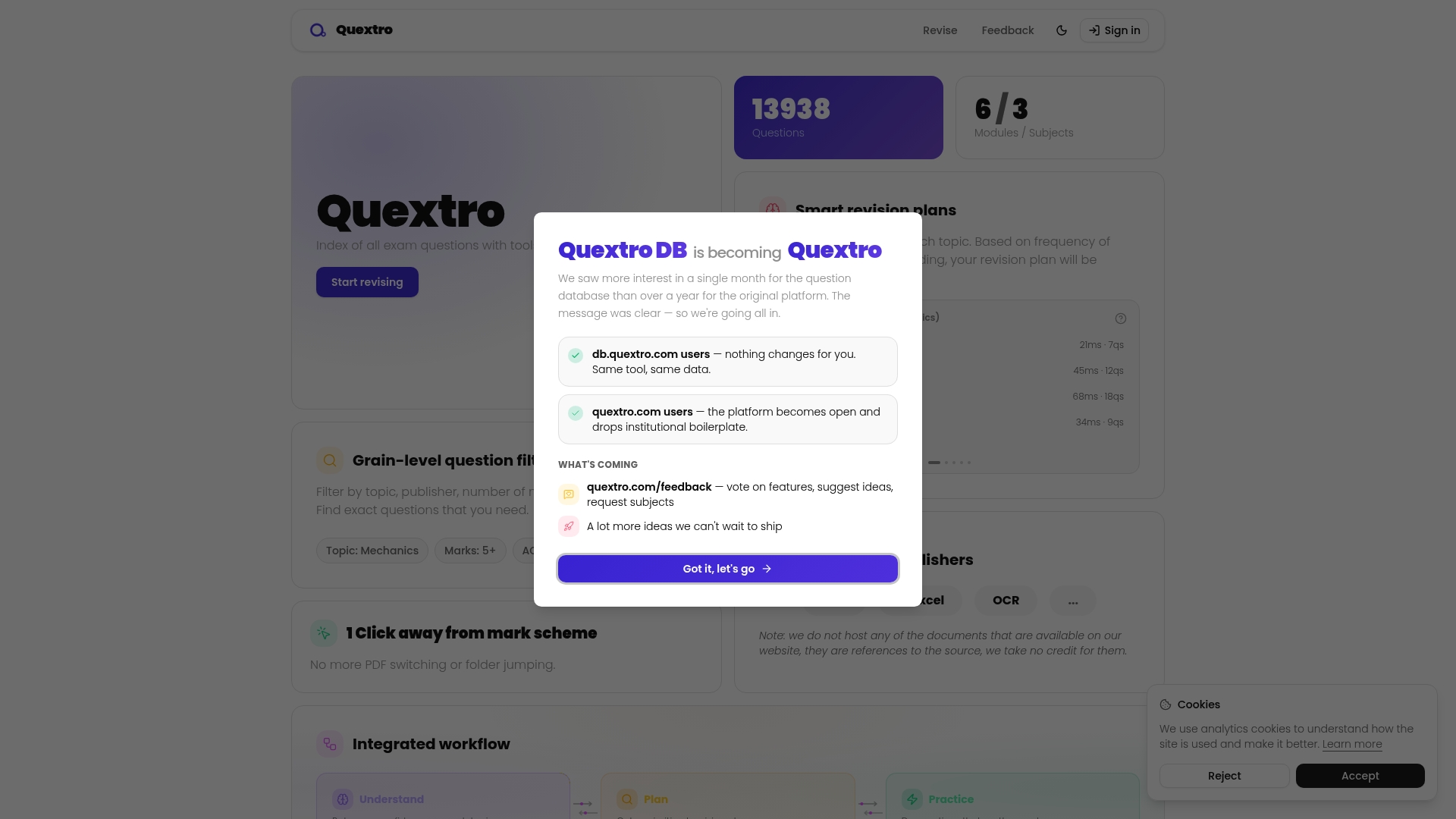
Quextro gives you access to over 13,955 past exam questions from AQA, Edexcel, OCR, and CIE, all filterable by topic, difficulty, and mark allocation. Once your mock diagnostic reveals a weakness in, say, kinematics or trigonometry, you can browse the exam question database and pull every relevant question in that area immediately, without hunting through PDF papers. For statistics-focused revision, the statistics question database gives you a focused set of questions to drill exactly the gaps your mock identified. Smart revision plans, confidence ratings, and automatic progress tracking mean your effort goes where it is needed most.
Frequently asked questions
How many mock exams should I do before my A-level maths exam?
Ideally, complete at least one full mock in proper exam conditions, though further practice adds value for mastering timing, technique, and confidence across different question styles.
How do I use my mock exam results to improve?
Identify the exact topics where you lost marks, review the mark scheme carefully for each error, then target those areas with focused practice. Mocks reveal specific gaps that general revision cannot uncover.
Should I do mock exams in exam conditions?
Yes, absolutely. Exam conditions help internalise what earns marks and reduce errors caused by poor time management or working habits under pressure.
Are mock exams used for official A-level grades?
Centres may use mock evidence if formal exams are disrupted, so your mock can play a formal role. Regulators expect mocks to be retained as possible alternative evidence for awarding decisions.