

TL;DR:
- Students often mistakenly believe that doing more past papers improves their grades without a structured approach. Curated exam resources, aligned with the exam board and focused on weak areas, enable targeted, efficient revision that enhances exam performance. Using a systematic workflow with mark scheme analysis and databases maximizes learning from errors and builds confidence through deliberate practice.
Most students preparing for A Level mathematics make the same mistake: they assume that doing more past papers automatically leads to better grades. It does not. Working through paper after paper without a structured approach is the revision equivalent of running on a treadmill and expecting to arrive somewhere. What actually moves the needle is targeted, curated practice — using carefully selected resources that match your exam board, identify your weak spots, and push you to engage critically with your errors. This article breaks down exactly how to do that.
Table of Contents
- What are curated exam resources and why do they matter?
- The anatomy of a curated maths revision workflow
- How past paper databases supercharge targeted revision
- Mistakes to avoid and expert curation tips
- Putting it all together: designing your own curated revision plan
- What most students miss about curated revision for A Level maths
- Discover curated A Level maths resources to fast-track your success
- Frequently asked questions
Key Takeaways
| Point | Details |
|---|---|
| Curated resources boost results | Using targeted, exam-board-specific materials maximises your revision efficiency. |
| Follow a structured workflow | Attempt, analyse, and adapt using official papers and mark schemes for peak improvement. |
| Databases save valuable time | Topic-filtered question banks let you focus instantly on your weakest areas. |
| Avoid common mistakes | Align your resources with your syllabus and learn from every answer reviewed. |
What are curated exam resources and why do they matter?
Traditional revision often means printing off a stack of past papers, working through them in roughly chronological order, and ticking boxes as you go. The problem is that this approach treats all questions equally, when in reality some topics appear far more frequently in exams, and your personal weak areas may have nothing to do with the topics you happened to practise last.
Curated exam resources are different. They are deliberately chosen, organised, and filtered to serve a specific purpose: getting you better results in less time. A curated resource is not just any worksheet or video. It is content that has been selected because it aligns with your exam board's specification, addresses a genuine learning gap, or reflects the style and difficulty of real exam questions.
What falls under this umbrella? Quite a few things:
- Official past papers and mark schemes from your exam board
- Topic-tagged question banks filtered by difficulty or mark allocation
- Examiner reports that highlight where students typically lose marks
- Specification checklists aligned to individual units or modules
- Revision notes written specifically for the paper you are sitting
AQA past papers, mark schemes, and exam reports represent the gold standard for curated practice. Every question has been professionally set, peer-reviewed, and used in live examinations, making them the most reliable benchmark for your own preparation.
One significant advantage of curated resources is that they save you the cognitive effort of sorting through irrelevant material. When you know that a particular integration topic accounts for a large portion of marks in your paper, spending time on curated questions targeting exactly that area is far more efficient than working through a generic revision guide. For a deeper look at how past paper revision practice shapes exam performance, the evidence consistently points to targeted engagement over sheer volume.
Pro Tip: Build a short resource checklist before you sit down to revise. Confirm that every item on your list is directly linked to your specific exam board's current specification. One mismatched textbook chapter can send your preparation in entirely the wrong direction.
The anatomy of a curated maths revision workflow
With an understanding of what curated resources are, let's map out an efficient study process. The best revision workflows are not random. They follow a repeatable cycle that builds competence gradually and keeps you honest about what you actually understand versus what you think you understand.
Here is a step-by-step process that works:
- Select a specific topic from your specification, ideally one you have rated as low confidence.
- Attempt a set of curated questions on that topic, ideally from different years or papers to expose yourself to varied phrasing.
- Self-mark using the official mark scheme, noting every method mark and accuracy mark you missed.
- Analyse your errors with a genuine critical eye. Was it a conceptual gap, a careless arithmetic slip, or a misreading of the question?
- Target the gap using board-aligned revision notes or worked examples that directly address what the mark scheme revealed.
- Repeat the cycle on the same topic until your accuracy improves noticeably before moving on.
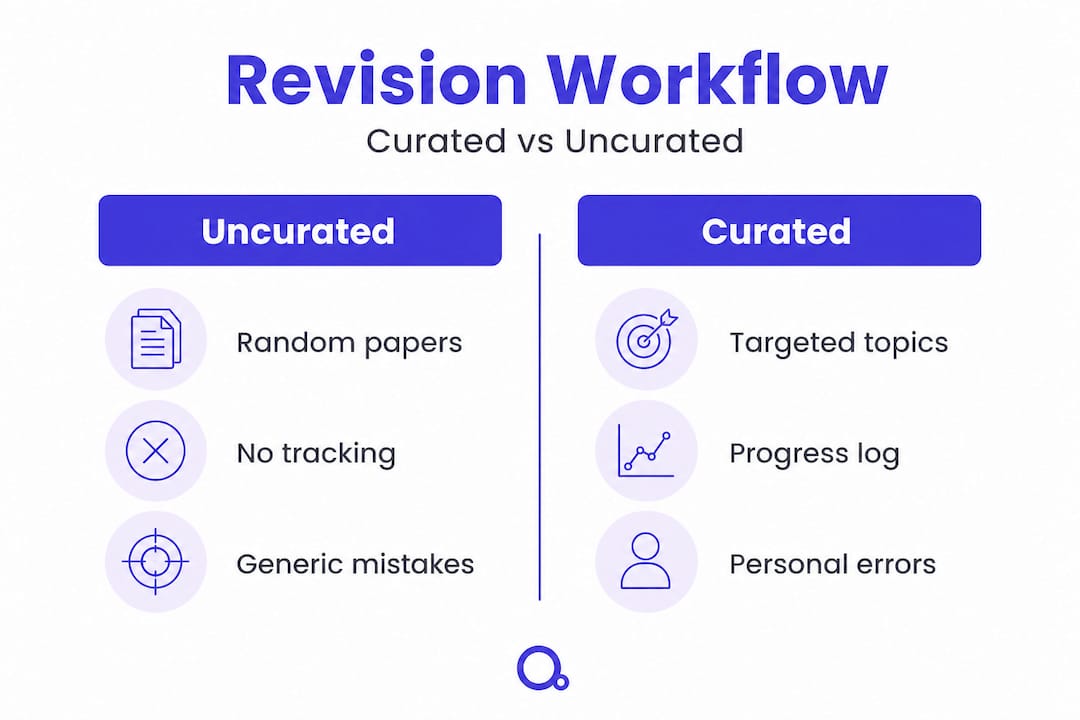
The key distinction between an uncurated and a curated workflow is what happens after you attempt the question. Most students mark their work and move on. The best students treat using a mark scheme as a diagnostic tool, not just a scoring mechanism.
| Feature | Uncurated revision | Curated revision |
|---|---|---|
| Resource selection | Ad hoc, often random | Deliberate, specification-aligned |
| Question source | Mixed boards and years | Board-specific, topic-filtered |
| Post-attempt review | Mark and move on | Deep mark scheme analysis |
| Progress tracking | Informal or absent | Structured and recorded |
| Time efficiency | Low, covers irrelevant areas | High, targets weak spots only |
| Confidence building | Uneven | Systematic and measurable |
This table makes clear that curated revision is not just about working harder. It is about removing the noise so your effort lands where it matters. A high-quality curated workflow for A Level Maths involves mark scheme analysis as a core activity, using board-aligned revision notes to plug precisely the gaps that practice questions reveal.
Pro Tip: After each revision session, write down one specific misconception you corrected. This makes your learning tangible and gives you a running record of genuine progress rather than just hours spent studying.
How past paper databases supercharge targeted revision
Once you've set up a workflow, leveraging curated databases can take your revision to the next level. The traditional approach of downloading full past papers and working through them from Question 1 to Question 12 is fine as a final exam simulation. But in the months leading up to your exams, it is far more powerful to work with a searchable, filterable database.
Past paper databases allow you to pull up every question ever set on, say, the binomial expansion or differential equations, across multiple years, in one place. This lets you spot patterns in how the topic is examined, identify the marks associated with specific question types, and practise the exact style of question that your examiner favours.

Here is a comparison of what different resource types actually deliver:
| Resource type | Searchability | Topic filtering | Mark scheme included | Examiner insight |
|---|---|---|---|---|
| Printed textbook | None | Limited | No | No |
| Generic revision website | Basic | Partial | Sometimes | Rarely |
| Official board website | Moderate | By paper | Yes | Sometimes |
| Curated question database | High | By topic and difficulty | Yes | Often |
The advantages of working with a well-organised database are significant:
- Fast identification of question trends: You can see at a glance which sub-topics appear every single year versus those that appear rarely.
- Targeted weakness exposure: Rather than waiting for a weak topic to appear in a full paper, you can force yourself to confront it immediately.
- Confidence building: Completing a focused set of questions on one topic and scoring well gives you specific, meaningful confidence rather than vague reassurance.
- Time saving: You stop wasting revision sessions on areas you already understand well.
AQA past papers and exam reports remain the benchmark resource, and knowing how to fully exploit them is a skill in itself. For an in-depth look at how to maximise your sessions, the guide on reviewing past papers walks through a structured approach that many students overlook entirely.
Mistakes to avoid and expert curation tips
Before you finalise your revision strategy, it is worth knowing common mistakes and hearing a few expert curation tips. Even students who are trying to revise smartly often undermine themselves with habits they do not realise are a problem.
The most common pitfalls include:
- Using resources from the wrong exam board. A question from Edexcel may look similar to an AQA question but reward answers differently. Mixing boards without awareness of specification differences is a real risk.
- Relying on generic revision guides over official materials. Revision guides are useful summaries but they are not written by examiners. The official papers and mark schemes are.
- Skipping the answer analysis step. Marking your work and immediately moving to the next question is the most common revision error. You learn almost nothing from marking alone. The learning happens in the analysis.
- Cherry-picking comfortable topics. Students naturally gravitate toward topics they already understand. A curated approach requires you to identify and face your weakest areas deliberately.
- Ignoring examiner reports. These documents explain exactly where the cohort lost marks and why. They are one of the most valuable free resources available and almost entirely overlooked.
A high-quality curated revision workflow uses official past papers and mark schemes for targeted practice, then uses board-aligned revision notes to plug precisely the gaps those mark schemes reveal. This is the method that separates consistent A grade students from those who plateau.
Here are the dos that replace those common errors:
- Do confirm your exam board and paper code before selecting any resource.
- Do read the examiner report for your current spec before you begin serious revision.
- Do spend at least as much time reviewing your answers as attempting questions.
- Do keep a written log of recurring mistakes by topic.
- Do practise analysing question patterns across multiple years to spot which topics the examiners return to consistently.
Pro Tip: Always cross-check any revision resource against the latest mark scheme and examiner report. Specifications do change and older resources can reflect content that is no longer assessed or miss newly added material.
Putting it all together: designing your own curated revision plan
With pitfalls avoided, you're ready to build a tailored, efficient revision plan. The goal here is not complexity. The best revision plans are simple enough to follow consistently and flexible enough to adapt as your strengths develop.
Here is how to structure yours:
- Map the full specification for your exam board and paper. List every topic and sub-topic. This becomes your master checklist.
- Rate your confidence on each topic honestly, using a simple scale such as low, medium, or high. Be ruthless here. Self-deception is expensive at A Level.
- Prioritise low-confidence topics and allocate more revision time to them. This feels uncomfortable, which is how you know it is working.
- Select curated questions from your exam board for each priority topic. Work in focused sessions of 30 to 45 minutes per topic.
- Review every answer using mark schemes and note errors in a dedicated revision notebook.
- Track your progress by re-rating your confidence weekly. Topics that improve can receive less time; topics that remain weak stay at the top of your list.
- Integrate full past papers once your topic-level confidence improves, using them as timed simulations to build exam stamina.
The AQA maths revision guide is an excellent companion for structuring this process, particularly for those sitting AQA papers. AQA provides past papers, mark schemes, and exam reports that make building a curated plan like this genuinely achievable without needing expensive tutoring.
Pro Tip: Treat your revision plan as a living document. Update it every week based on your actual performance, not on how confident you feel going in. Performance data from mark schemes is objective. Your gut feeling about how revision is going is often wrong.
What most students miss about curated revision for A Level maths
Stepping back, there is a hard-won insight about curated revision that most articles overlook: surface-level curation is not enough. Many students now use topic-filtered question banks and still stall in their grade improvement. The reason is that they are curating their inputs without curating their reflection.
Selecting the right questions is the first step. But the real gains come from what happens after you mark your work. The students who make the largest leaps between mock and real exams are not always the ones who did the most questions. They are the ones who treated every single mark scheme as a detailed feedback letter, written specifically for them, explaining how to think about the problem more clearly.
There is a crucial difference between reviewing exam answers to find out your score and reviewing exam answers to understand why the examiner's method is more elegant or efficient than yours. The latter requires intellectual humility. It means sitting with a wrong answer long enough to genuinely change the way you think about a topic, rather than just noting that you got it wrong and moving on.
Savvy revision is not about more papers. It is about smarter engagement with your errors. Every mistake is information. A curated revision plan that does not include a rigorous self-feedback loop is just organised box-ticking.
Discover curated A Level maths resources to fast-track your success
Armed with a personalised plan and an expert mindset, the next step is finding a platform that brings all these curated resources together in one place.
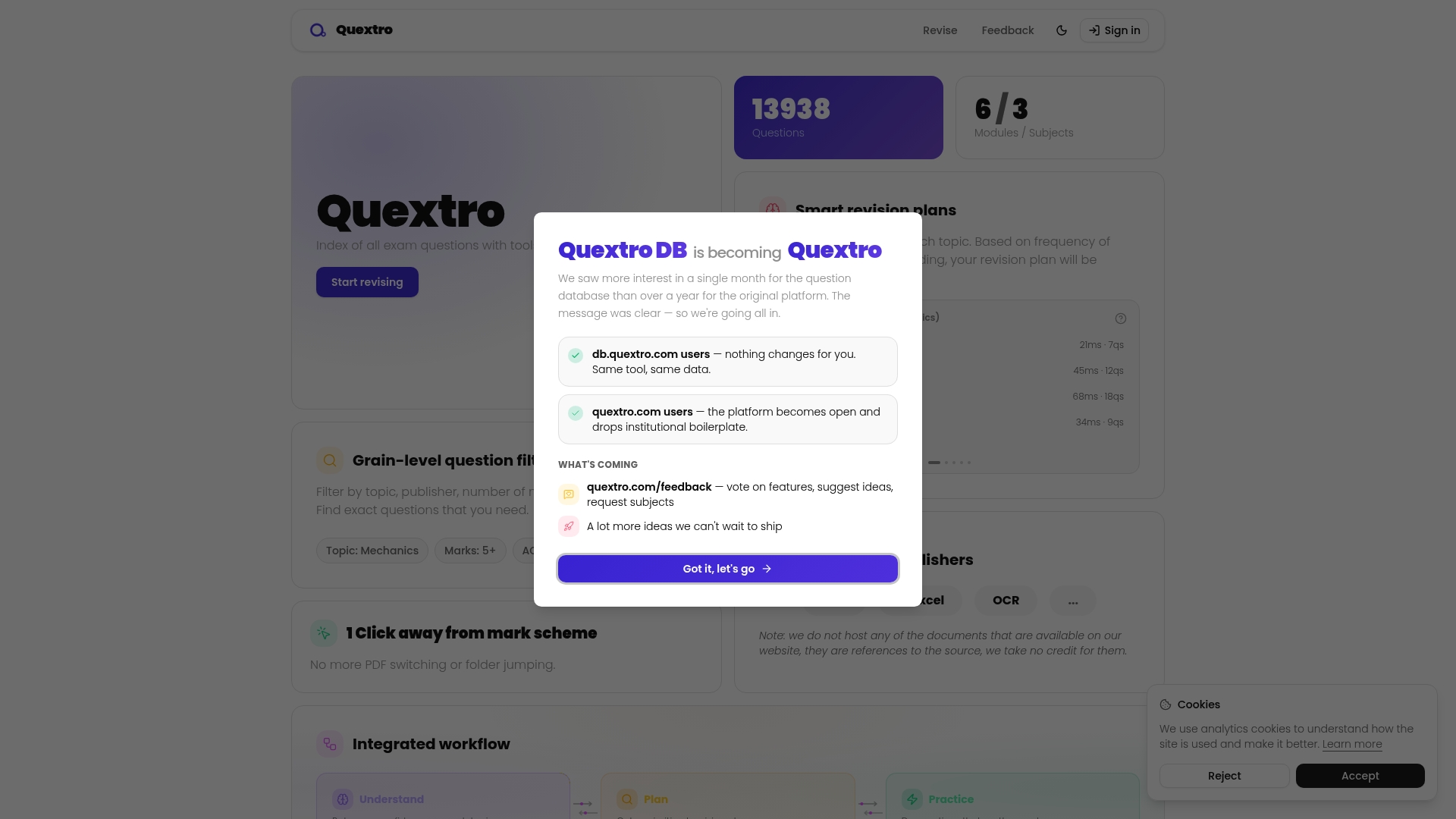
Quextro is built specifically for A Level maths students who want targeted, efficient revision. The platform hosts over 13,955 past exam questions from AQA, Edexcel, OCR, and CIE, all fully searchable and filterable by topic, difficulty, and mark allocation. You can answer questions directly on the site, track your confidence by topic, and build a smart revision plan that adapts as your performance improves. There is no need to download PDFs or manage separate files. Everything from question selection to progress tracking lives in one intuitive workflow. If you are serious about using curated resources the right way, Quextro is the most direct path to doing it properly.
Frequently asked questions
Where can I find official A Level maths past papers and mark schemes?
AQA past papers and mark schemes are available via the AQA All About Maths website, and your school's exam resources portal may also provide access through Centre Services.
How do I identify my weakest maths topics using curated resources?
Practise with topical question sets and use the mark scheme to spot recurring errors. Board-aligned revision notes can then target the specific gaps those errors reveal.
Are curated resources better than textbooks for A Level maths revision?
Yes, for exam preparation specifically. Curated resources focus directly on likely exam content and your personal weaknesses, whereas textbooks cover everything regardless of exam relevance.
What is the best way to use past paper databases?
Filter questions by topic and difficulty, attempt them under timed conditions, and then review every answer carefully using the corresponding mark scheme for genuine learning. AQA exam reports add another layer of insight that most students skip.